Advertising Trends: From Influencers to Artificial Agents
Advertising in its simplest definition is how brands communicate with their consumers.
Whether it is short-form content to throw the loudest and fastest imagery or songs at us, social media influencers letting their famous faces do the talking, or even artificial intelligence doing the heavy lifting behind the scenes, brands are finding new ways to talk to us consumers. Advertising has always been a facet of both context and concepts. Many advertising campaigns have been utilized to influence how customers think, while also providing ways to “solve” the very potential problem that they are examining. One of the most famous examples is the boom of cigarette advertising that promoted doctors having examined the effects the tobacco and providing its usefulness over other brands to convince the masses to smoke more. Trends are developed from the interest in anything technological, ecological, economic or societal and how brands or advertisers can best use them to derive some emotion at a quick glance. The main three that I have identified as both trendy and quick to incite emotion that best exemplify the advancements in advertising: artificial intelligence, short-form content and influencer advertising.
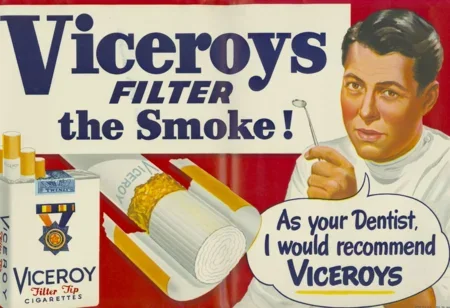
Cigarette advertisements often gave doctor’s voices…
Trend #1: Artificial Intelligence
Artificial intelligence, while occasionally controversial, has proven to show true advertising aids to brands and communication with consumers. 24/7 AI chatbots that are available to help on sites and with any consumer’s need, algorithm optimization that helps read a consumer’s interests and provides them content they are most likely to be interested in, and personalization that goes deeper into optimization and creates new paths for consumers entirely. These tools have given brands a way to know what consumers are thinking about various products or services, what they would like to see from brands and how to develop their products and services more, and even the customers themselves and what they generally think or believe across any kind of industry. AI agents and tools are becoming more of a magnifying glass into the lives of the people around us, their dreams, their tragedies and even their secrets.
In comparison to a decade ago, artificial intelligence was an extreme technological feat. The first ever artificial intelligence advertisement came from a company named “M&C Saatchi,” that sought to use this opportunity to create something that nobody has ever dreamed of. In 2015, this was something more than just a Darwinian experiment, as FastCompany puts it, it was a picture into the future. The advertisement may have only been used for a coffee brand, but the ability to have an algorithm design something like this also mapped exactly how anyone and everyone thought about this, not necessarily the coffee. David Cox, the Chief Innovation Officer at the time of this advertisement’s implementation, offered that it was only the beginning, if artificial intelligence could handle that workload, there would be endless applications for its uses.
Trend #2: Short-Form Content
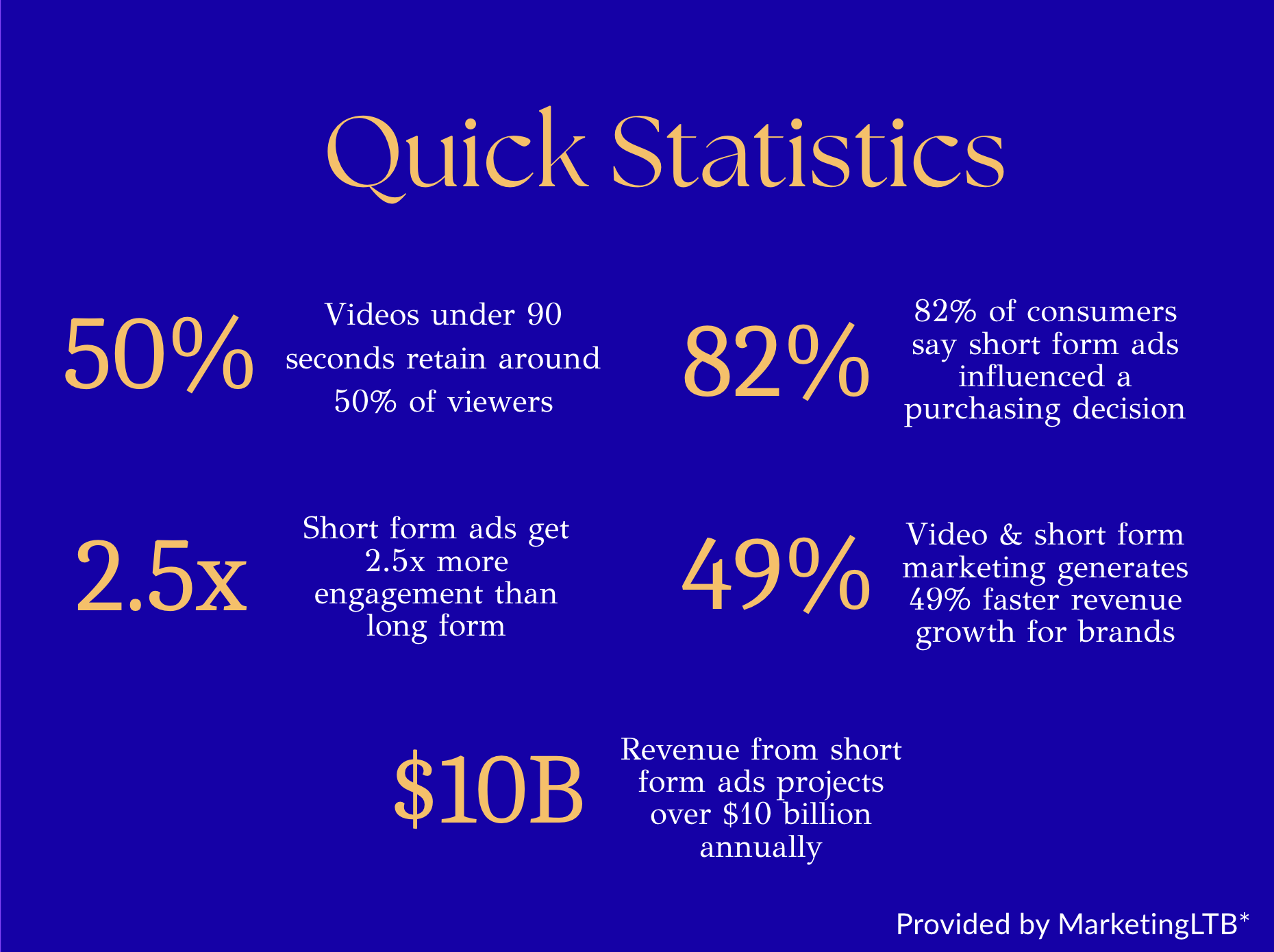
TikTok and Instagram Reels are quickly becoming some of the most viewed and admired content in this landscape of technology. Social media has had some connection with diminishing user’s attention spans, so when content is under a minute long with quick punchlines and occasionally having soulless content, it creates new opportunities for brands to connect with consumers. Opposed to movie trailers and longer form content that can be useful for certain information, short-form videos and advertisement provides a low-cost but highly effective way to communicate with consumers. Per Basis, 65% of online users engage with short-form content via TikTok or other platforms, with 1 in 4 of those users being influenced to making purchasing decisions based on the content and advertising presented to them. These numbers are showing the vast increase in not only spending, but time and decisions spent online.
In an academic study from the Journal of Retailing and Consumer Services, a study with several components ranging from consumer engagement and performance expectations to sales approach and control variables was conducted to determine the viability of short-form advertising. The data and results that were concluded from this study were that when an ad is good, it useful, but advertising has to have a level of believability to them to drive consumers to interacting with their products and services. When brands and advertisers are able to create a connection on belief and understanding with their consumers, then sales approach, tie strength and even control variables become easier to designate and develop. The easier that certain variables are able to be developed, then it will continue the circle of maintaining effective and ethical advertising for consumers that are looking for it, all while making a lot of money. On the other side of the coin, when ads are not believable and do not post truthful or ethical content to consumers, there is not only a less likelihood consumers will purchase any products or services, but it will drive them to potential competitors. Word of mouth is a huge variable within the advertising world, and the spread of poor content can ruin any publicity or image a company once had.
Trend #3: Social Media Influencer Advertising
The term “influencer” is still relatively new and sometimes overused, but the concept of an advertisement having an endorsement, is not. Athletes, movie stars, activists, politicians and presidents, and now big social media powerhouse names are some of the most popular ways to endorse a product or service to create communication and traction within the advertising space and consumers. Social media is one of the most important uses of advertising in 2026, there are millions of users every single day that are all on different platforms, and being able to advertise content to them through a creator’s likeness improves the effectiveness of the ad. The numbers of social media users are staggering with just a decade of numbers. In 2015, there was an estimated 2 million users of platforms, granted there were not as many or advanced platforms that we have today, but the number of those online were still plentiful. But a decade later reports over 5 billion users worldwide, providing endless opportunities and options for brands and advertisers to take advantage of how popular influencers are becoming.
This video is an example of a company relying on the popularity of a social media influencer to do the work for them before the ad even begins. Up front and center is a man named Mr. Beast, one of the most prolific influencers on the internet today. Mr Beast not only has the highest subscriber number on YouTube with 472 million, but his popularity among kids and adults through his various games and exciting entertainment creates an estimated $10-100 million in revenue each year (SocialBlade). These numbers are what brings Mr. Beast up in conversation when companies need a spokesperson or a familiar face to drive a special campaign, and with SalesForce utilizing his fame in their 2026 Super Bowl ad, they took full advantage. the main component of their ad is to promote their new artificial intelligence systems, but with a fun Mr. Beast twist.
In an academic study from the International Journal of Advertising, a comparison was developed of how a content creator’s social media popularity affected their ability to promote and sell products. The control group of influencers were from a fitness background, with varying content style, content length, and even different types of bodies and workout types. Overall, there was a high connection between better physical appearance, more social media followers, and higher product sales. As consumers, when we are presented with multiple options to achieve a similar goal, we tend to side with those that most likely achieved or are achieving our end goals. The summary of the study had shown there is little emotional decision that is justified when making these decisions between influencers, it is purely statistical and imaginative.
Sources Used:
(In order of usage)
Online Articles and Statistics:
Stine, J. (2014, March 17). Smoke gets in your eyes: 20th century tobacco advertisements. National Museum of American History. https://americanhistory.si.edu/explore/stories/smoke-gets-your-eyes-20th-century-tobacco-advertisements
Carter, M. (2015, June 23). This “World’s first” artificially intelligent ad is a test of automated creativity. Fast Company. https://www.fastcompany.com/3048944/this-worlds-first-artificially-intelligent-ad-is-a-test-of-automated-creativity
M&C Saatchi London. (2015, July 10). Artificially Intelligent Poster. YouTube.
Reschke, M. (2025, February 3). How short-form video is changing advertising. Basis. https://basis.com/blog/how-short-form-video-is-changing-advertising
Nash, B. (2025, October 17). Short form video statistics 2025: 97+ stats & insights [expert analysis] - marketing LTB. Marketing LTB. https://marketingltb.com/blog/statistics/short-form-video-statistics/
Multiple. (2025, November 19). Social Network Usage & Growth Statistics (2026). Backlinko. https://backlinko.com/social-media-users
SalesForce, & Slack. (2026, February 8). SalesForce Big Game Ad: Mr Beast’s Vault. YouTube. https://www.youtube.com/watch?v=Lp9OEfkWfLI&t=1s
MRBEAST’s YouTube statistics. Social Blade. (n.d.). https://socialblade.com/youtube/handle/mrbeast
Academic Journals and Studies:
Gao, B., Wang, Y., Xie, H., Hu, Y., & Hu, Y. (2023). Artificial Intelligence in advertising: Advancements, challenges, and ethical considerations in targeting, personalization, content creation, and ad optimization. Sage Open, 13(4). https://doi.org/10.1177/21582440231210759
Xiao, L., Li, X., & Zhang, Y. (2023). Exploring the factors influencing consumer engagement behavior regarding short-form video advertising: A big data perspective. Journal of Retailing and Consumer Services, 70, 103170. https://doi.org/10.1016/j.jretconser.2022.103170
Janssen, L., Schouten, A. P., & Croes, E. A. (2021). Influencer advertising on Instagram: Product-influencer fit and number of followers affect advertising outcomes and influencer evaluations via credibility and identification. International Journal of Advertising, 41(1), 101–127. https://doi.org/10.1080/02650487.2021.1994205
